

Gutenberg’s Printing Press: How One Invention Changed How the World Learns

Imagine a world where every book on Earth is copied by hand. A single Bible takes a scribe the better part of a year, mistakes creep in with every copy, and owning a book means being rich or being a monastery. Then, in a workshop in the German city of Mainz, a goldsmith finds a way to make a thousand identical pages as easily as one. This guide explains exactly how Gutenberg’s system worked, what it was built on, and how it reached India.
| Inventor | Johannes Gutenberg, goldsmith and metalworker of Mainz |
| Key idea | Movable metal type cast in a mould, with oil-based ink and a screw press |
| Famous product | The 42-line Bible, printed in 1454 to 1455 |
| Copies of the Bible | Roughly 120 to 160, most on paper, some on vellum (Library of Congress) |
| Built on | Paper (from China via the Islamic world), woodblock printing, Korean metal type |
| Reached India | Goa, 1556, by Jesuit missionaries |
| Reading time | 10 min read |
Before Gutenberg: copying by hand
In medieval Europe, books were made in scriptoria, writing rooms in monasteries and later in university towns. A skilled scribe copied a text letter by letter onto parchment, and illuminators added painted initials. The results were beautiful and expensive. A large Bible could take a scribe a year or more, and because every copy was hand-made, errors multiplied: the third copy of a copy might differ in hundreds of places.
Printing itself was not new. In China, woodblock printing is documented from the 700s. The Diamond Sutra, printed in 868 CE and now in the British Library, is the oldest dated printed book. Carving a whole page into a block of wood, though, means a new block for every page. The Chinese printer Bi Sheng solved that around the 1040s with movable type made of baked clay. Later, in Korea, metal type was used to print the Buddhist text Jikji in 1377, the oldest surviving book printed with metal type.
So why did Gutenberg’s method change Europe more than these earlier inventions changed East Asia? Part of the answer is the writing system. A Latin-alphabet book needs only a few dozen kinds of letters, while Chinese needs thousands of characters, so a type case is hugely more practical for an alphabet. The rest of the answer is that Gutenberg combined several technologies into a repeatable production system.
Who was Johannes Gutenberg
Johannes Gensfleisch zur Laden zum Gutenberg was born in Mainz around 1400 into a family connected with the city’s mint, which meant he grew up around metalworking. He spent time in Strasbourg in the 1430s, where a lawsuit record shows he was running a business making polished metal mirrors for pilgrims and had a secret project on the side. By around 1448 he was back in Mainz and borrowing money from a wealthy lender, Johann Fust, to build a printing workshop.
The partnership ended badly. Around 1455, Fust sued over the loans and won the printing equipment. Gutenberg’s later years are poorly documented, and he died in 1468. The Bible he created became his monument, though his name does not appear in it: early printers often did not sign their work.
The invention: five parts that work together
Gutenberg’s genius was systems thinking. Each part below existed or was adapted from something else, but together they let a small team produce hundreds of identical, readable pages.
- A hand mould for casting type. A letter shape is cut into a steel punch, struck into a softer metal to make a matrix, and the matrix is placed in an adjustable mould. Pour molten metal in, and you get a letter, identical to the last one, in seconds.
- A good alloy. The metal was mostly lead, with tin and antimony added. Lead alone is too soft; the alloy melts easily, casts cleanly and hardens enough to survive thousands of impressions.
- Oil-based ink. Scribes’ water-based inks bead on metal. Gutenberg used a thick varnish of boiled linseed oil and soot that sticks to metal type and transfers sharply to paper.
- A press. He adapted the screw press used for wine, olives and paper. A flat plate presses the paper evenly against the inked type.
- A typeface made for the job. Gutenberg’s typeface imitated the dense Gothic handwriting of German scribes, with many ligatures and abbreviations: around 290 different characters in all. That made the page look familiar to readers.
How one page was printed, step by step
Cast the type
Letters are cast one by one from the mould and stored in a case, with capital letters in an upper case and small letters in a lower case. This is where the terms upper-case and lower-case come from.
Set the line
The compositor picks letters from the case and arranges them backwards, left to right, in a hand-held composing stick. Each letter is a mirror image so the print comes out the right way round.
Lock the page
Lines are gathered into a frame called a forme and locked tight, so that nothing wobbles under pressure.
Ink the type
A pressman dabs the surface with leather ink balls to spread a thin, even layer of oil-based ink.
Place the paper
A dampened sheet of paper is laid over the type and folded into position.
Pull the bar
The screw is turned and the platen presses the paper against the type for an instant.
Hang it up to dry
The printed sheet is hung to dry, while the type is inked again for the next sheet. The type is later cleaned and sorted back into the case for the next page.
Try it: set type like a printer
Type a line and see it as a compositor would: mirrored, ready for the press. The tool also counts how many pieces of type you would need.
Counting sorts in Python
Each piece of type is called a sort. To print a page, the shop needed many copies of common letters. The script below counts the sorts for one line of Latin, the language of Gutenberg’s Bible. It opens with the famous first line of Genesis in the Vulgate.
from collections import Counter

line = "In principio creavit Deus caelum et terram"
letters = [c for c in line.lower() if c.isalpha()]
counts = Counter(letters)

print(f"Line: {line}")
print(f"Letters to set: {len(letters)}  |  different letters: {len(counts)}")
for ch, n in counts.most_common(5):
    print(f"  {ch!r} x {n}")
Output:
Line: In principio creavit Deus caelum et terram
Letters to set: 36  |  different letters: 15
  'i' x 5
  'e' x 5
  'r' x 4
  'c' x 3
  'a' x 3
Just 36 letters from 15 different sorts. Now scale up: a page of the Bible has two columns of 42 lines, so the shop needed thousands of sorts of the common letters, which is why Gutenberg’s mould and alloy mattered so much.
The 42-line Bible
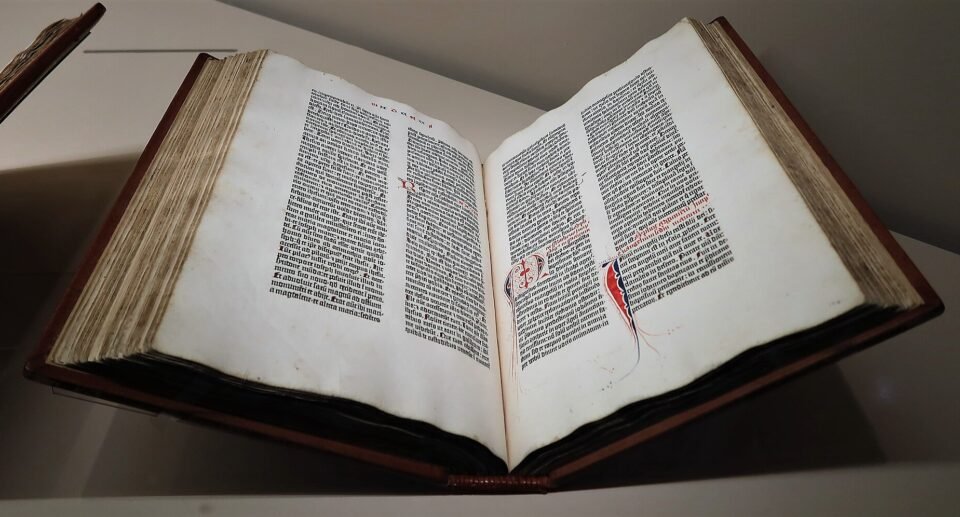
Gutenberg’s great work, completed in Mainz around 1454 to 1455, is a Latin Bible in two volumes of about 1,280 pages. Each page has two columns of 42 lines, so it is known as the 42-line Bible. The Library of Congress estimates that at least 120 copies were printed on paper and perhaps as many as 40 on vellum. Printers left blank spaces for initials and borders, which professional artists then painted by hand, so no two copies look exactly the same.
Scholars have studied surviving copies for centuries. The even ink, tidy lines and consistent letters show how good the system already was in its first major product.
How print spread
868: The Diamond Sutra
A Chinese woodblock-printed scroll, the oldest dated printed book.
c. 1040s: Bi Sheng’s clay type
The first known movable type, made of baked clay in China.
1377: Korean metal type
The Jikji is printed with metal movable type in Korea.
c. 1440s: Gutenberg’s workshop
Experiments in Strasbourg, then Mainz, build the full system of mould, alloy, ink and press.
1454-55: The 42-line Bible
Gutenberg’s great work comes off the press.
1457: The Mainz Psalter
Fust and Schoeffer print a Psalter with a colophon naming them and the date, the first dated printed book from the West.
1465: Italy
The first Italian press opens at Subiaco; Venice soon becomes a printing capital.
1476: England
William Caxton sets up a press at Westminster.
1517: The Reformation
Luther’s Ninety-five Theses spread across German lands in printed copies in a matter of weeks.
1556: Goa
Jesuits set up the first press in India at St Paul’s College, Old Goa.
Within a few decades of the Bible, presses were operating in hundreds of European towns. Prices fell, book production exploded, and the same book could be read in London, Venice and Kraków. That sameness mattered: scholars could now cite page numbers, compare diagrams and build on each other’s work without worrying about copying errors. Many historians connect print with the spread of Reformation ideas and with the Scientific Revolution.
Print arrives in India
The first printing press in India was set up in 1556 at St Paul’s College in Goa, run by the Spanish Jesuit João de Bustamante. The earliest book printed there was the Conclusões e outras coisas, a set of theses, in 1556. Goa became a centre for religious texts in Portuguese, Latin and Indian languages.
- Tamil: the first Tamil book printed in India was Henrique Henriques’ Doctrina Christam en Lingua Malauar Tamul, printed at Quilon in 1578.
- Bengali: in 1778 Nathaniel Halhed’s A Grammar of the Bengal Language was printed at Hooghly using Bengali type cut by Charles Wilkins.
- Newspapers: James Augustus Hicky’s Bengal Gazette appeared in Calcutta in 1780, widely considered India’s first newspaper.
- Serampore: from 1800 the Serampore Mission Press printed books in dozens of Indian languages and helped standardise typefaces for scripts such as Devanagari and Bengali.
In the 19th century Indians began running their own presses, and print became a tool for reformers, educators and the independence movement. The same logic that Gutenberg used, cheap identical copies of an idea, drove newspapers, textbooks and pamphlets across the country.
Mind map: printing at a glance
- Printing: How a Mainz goldsmith turned books into a mass medium.
- Before Gutenberg: Copying and early printing.
- Scribes: Every book copied by hand, often in monasteries.
- Woodblock printing: China: the Diamond Sutra of 868 is the oldest dated printed book.
- Bi Sheng: Clay movable type in China, around 1040s.
- Korean metal type: The Jikji, 1377, is the oldest surviving book printed with metal type.
- Gutenberg’s system: Five pieces that had to work together.
- Type mould: Cast identical letters quickly.
- Metal alloy: Lead, tin and antimony: hard, melts easily.
- Oil-based ink: Sticks to metal type, unlike water ink.
- Screw press: Adapted from wine and paper presses.
- Latin Textura type: About 290 characters, ligatures included.
- The 42-line Bible: Printed in Mainz, about 1454 to 1455.
- Two columns: 42 lines in each column.
- Paper and vellum: Most copies on paper; some on vellum.
- Hand finishing: Initials and borders painted in afterwards.
- Spread: From one city to a continent.
- Italy, 1465: Subiaco, then Venice.
- England, 1476: William Caxton at Westminster.
- Goa, 1556: First press in India.
- Serampore, 1800: Printing in Indian languages at scale.
- Impact: What print changed.
- Reformation: Luther’s ideas spread fast in print.
- Science: Identical diagrams and tables for all.
- Literacy: Cheaper books, more readers.
- News: Pamphlets and newspapers.
- Before Gutenberg: Copying and early printing.
Common myths
- Myth: Gutenberg invented printing. Printing existed in China and Korea long before; he invented a practical system for European alphabets.
- Myth: The Bible was printed on cheap, plain paper only. Some copies were printed on vellum, and all were finished by hand with decorative initials.
- Myth: Gutenberg got rich. He lost his equipment in a lawsuit and the profits went to others.
- Myth: Print instantly replaced manuscripts. For years printers imitated manuscript style, and hand-copying continued for some purposes.
Key takeaways
- Gutenberg’s breakthrough was a system: mould, alloy, ink, press and typeface working together.
- It built on paper, woodblock printing and Korean metal type.
- Cheap, identical copies let ideas spread and made knowledge easier to check and build on.
- Print reached India in 1556 and later became a tool for reform, education and news.
Frequently asked questions
Did Gutenberg print anything before the Bible?
Yes. Small items such as calendars and indulgence letters are attributed to his workshop. They helped the press earn money while the Bible was being prepared.
Why do we say upper case and lower case?
Printers stored capital letters in the upper drawer of a type case and small letters in the lower drawer.
How many Gutenberg Bibles survive?
Fewer than fifty copies survive in whole or part, according to common estimates. The Library of Congress holds a complete vellum copy.
Is a printing press the same as a printer at home?
Both put ink on paper, but modern printers work from digital files and have no movable type.
Keep exploring
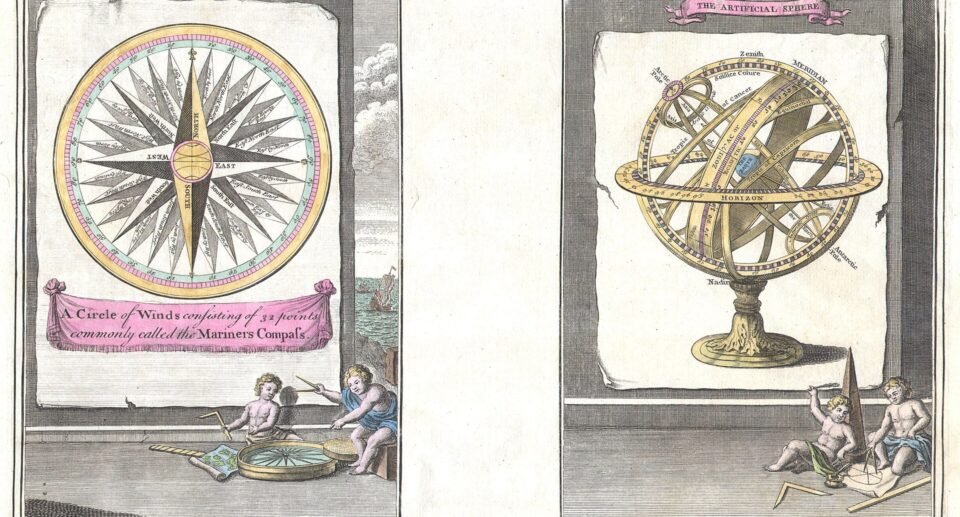
The material Gutenberg printed on.The compass
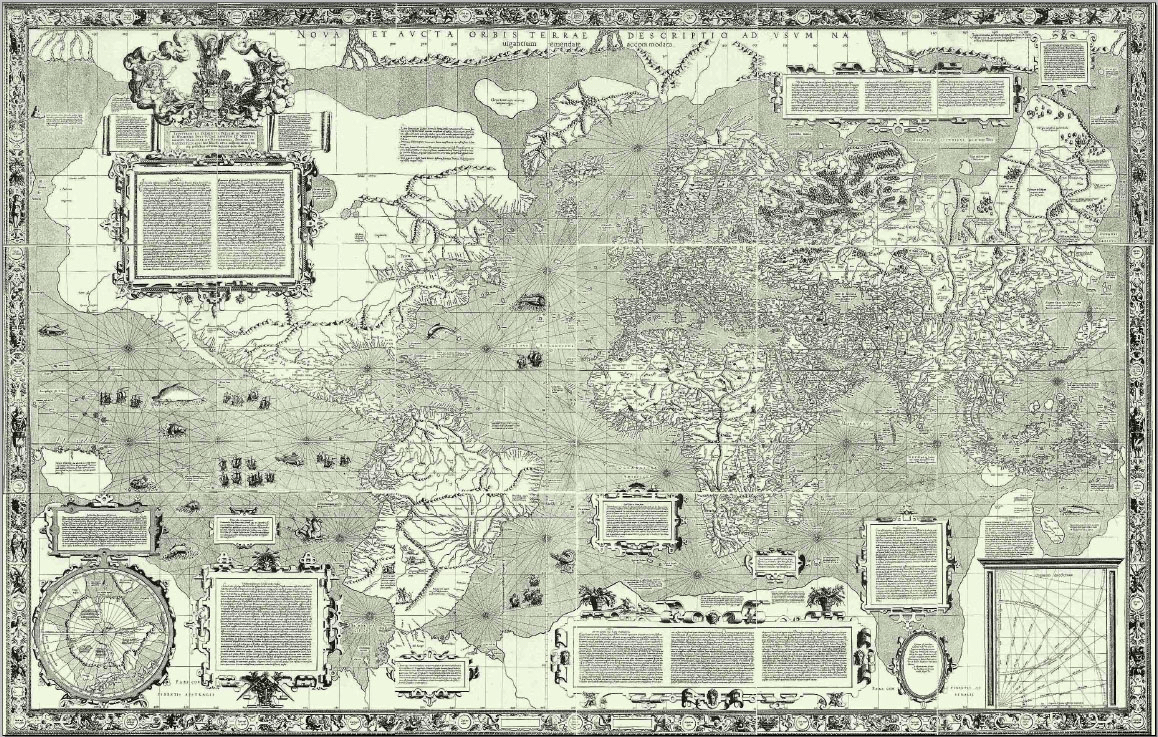
Another invention that opened up the world.Mind map of all inventions
See the whole story in one map.
Sources
- Johannes Gutenberg, Encyclopaedia Britannica
- Printing press, Encyclopaedia Britannica
- History of printing, Encyclopaedia Britannica
- Gutenberg Bible: frequently asked questions, Library of Congress
- Nearly 1,000 years old, this text shows the ingenuity of Chinese woodblock printing, Smithsonian Magazine
- Printing in Goa, Wikipedia
Featured image: Image: Zythème, via Wikimedia Commons, CC0. Dates for early events are approximate.

1 Comment
[…] Communication & Writing Renaissance & Early Modern Oct 21, 2026 […]