
Mind Map: 2.6 Million Years of Inventions

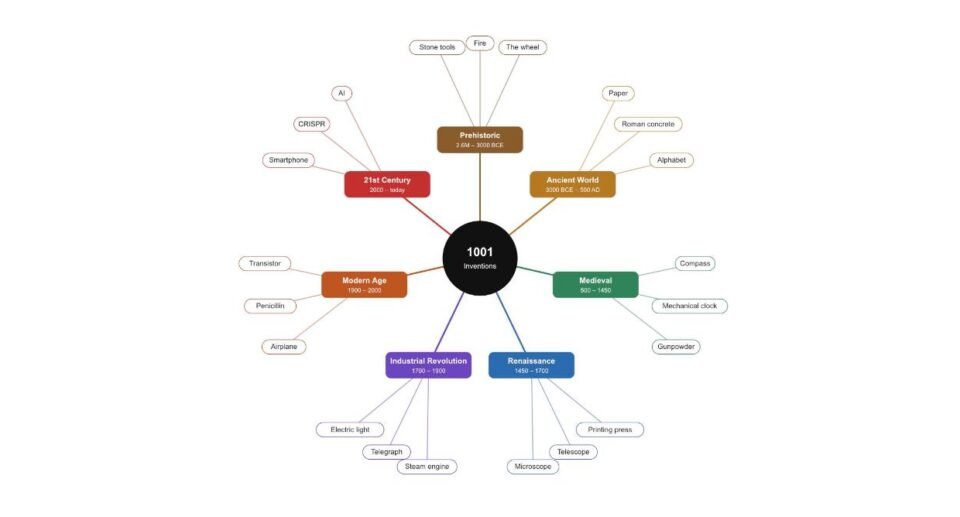
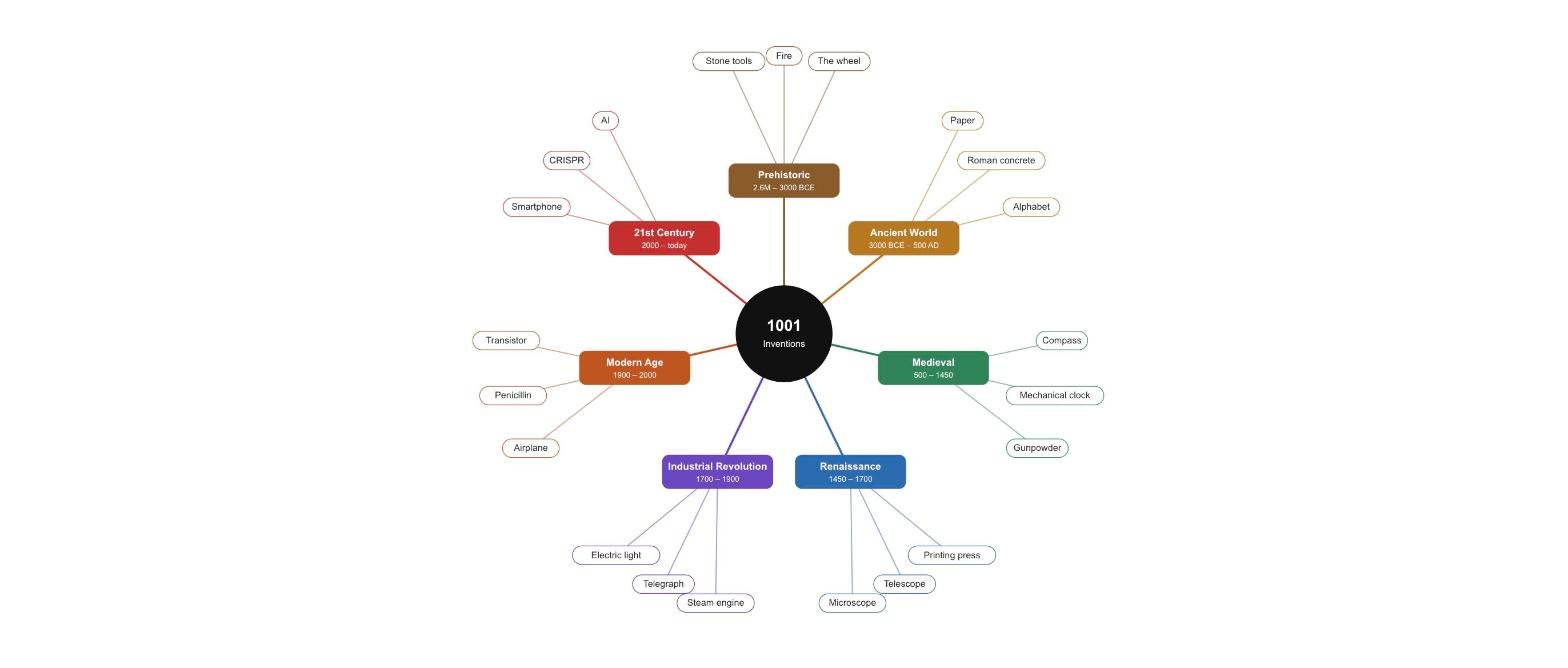
Two and a half million years of human ingenuity do not fit on one page, so we drew a map. Each branch below is an era or a theme. Click a branch to open it, drag the canvas to move around, and press Full screen for the big picture. Branches that have a full guide link straight to it.
Mind map 1: inventions by era
Start here if you like to think in time. Open a branch to see its key inventions, and click an invention to read what it did. Entries with a green button lead to a long guide.
- Inventions: Eight branches, one per era of human invention. Click a branch to open it.
- Prehistoric: Before 3000 BCE: tools, fire and the first farms.
- Stone tools: The oldest known stone tools are about 2.6 million years old and come from Africa.
- Control of fire: Cooking, warmth and protection. Evidence of controlled fire stretches back hundreds of thousands of years.
- Pottery: Fired clay vessels appear in East Asia more than 15,000 years ago.
- Agriculture: Farming began independently in several regions around 10,000 BCE.
- The wheel: Wheeled vehicles appear around 3500 BCE.
- Ancient: 3000 BCE to 500 CE: writing, numbers and big engineering.
- Writing: Cuneiform in Mesopotamia and hieroglyphs in Egypt, around 3200 BCE.
- Paper: Cai Lun refined papermaking in China in 105 CE.
- Zero: A number and a placeholder, fully developed in India.
- Roman concrete: Volcanic ash concrete that built the Pantheon.
- Indus drainage: Planned cities with covered drains around 2500 BCE.
- Medieval: 500 to 1400: navigation, powder and spectacles.
- Compass: A floating needle for finding direction at sea.
- Gunpowder: Developed in China, spread west over centuries.
- Mechanical clock: Weight-driven clocks in European towers, around 1300.
- Spectacles: Reading glasses appear in Italy in the late 1200s.
- Algebra: Al-Khwarizmi’s book gave the subject its name, around 820 CE.
- Renaissance: 1400 to 1700: print, optics and better maps.
- Printing press: Gutenberg’s movable-type press, around 1440.
- Mercator map: A map projection built for sailors, 1569.
- Telescope: First used for astronomy around 1609.
- Microscope: Opened up the world of cells and germs.
- Pendulum clock: Huygens, 1656: accurate timekeeping.
- Industrial: 1700 to 1900: engines, light and wires.
- Steam power: From Newcomen and Watt to railways.
- Photography: Fixing light on a plate, 1820s-1830s.
- Vaccination: Jenner, 1796.
- Telegraph: Messages as electric pulses.
- Electric light: Practical lamps from the late 1870s.
- Modern: 1900 to 2000: antibiotics, chips and rockets.
- Penicillin: Discovered in 1928; the first antibiotic.
- Transistor: Bell Labs, 1947: the switch behind all electronics.
- Space flight: Sputnik in 1957, Moon landing in 1969.
- Solar cell: The practical silicon cell appeared in 1954.
- Airplane: Powered flight in 1903.
- 21st century: 2000 onwards: phones, AI and electric roads.
- Smartphone: A computer, camera and phone in one pocket.
- Artificial intelligence: Machines that learn from data.
- Electric car: Older than the petrol car, now back.
- Mobile apps: Software for the pocket computer.
- mRNA vaccines: Designed in days, used worldwide from 2020.
- Prehistoric: Before 3000 BCE: tools, fire and the first farms.
Mind map 2: inventions by theme
Prefer to follow one idea through history? This map groups the same inventions by purpose. Notice how often one field leans on another: printing needed paper, the transistor needed zero-based mathematics, and smartphones need all of the above.
- Inventions: The same story, sorted by what the invention is for.
- Communication: How ideas travel.
- Writing and paper: Recorded memory.
- Printing press: Mass-produced books.
- Telegraph and telephone: Instant distance.
- Smartphone: Everything, everywhere.
- Transport: How people and goods move.
- The wheel: Where it started.
- Steam railways: Distance becomes time.
- Electric car: A comeback.
- Space flight: Beyond the planet.
- Medicine: How we fight disease.
- Vaccines: Training the body.
- Penicillin: The first antibiotic.
- mRNA vaccines: Programmable medicine.
- Computing: How we calculate and build software.
- Zero: Place value made modern maths possible.
- Transistor: The tiny switch.
- Artificial intelligence: Learning machines.
- Git: Version control for code.
- HTML, CSS and JavaScript: The web’s three languages.
- Mobile apps: Software for phones.
- Navigation and maps: How we find our way.
- Compass: Direction.
- Mercator map: Maps for sailors.
- Monsoon trade winds: The Indian Ocean highway.
- Energy: How we power things.
- Fire: The first energy technology.
- Steam: Heat into motion.
- Solar cell: Light into electricity.
- Building and materials: How we shape the world.
- Roman concrete: Long-lasting domes.
- Paper: A light, cheap material.
- Food, war and art: Farms, weapons and images.
- Agriculture: Settled life.
- Gunpowder: A military turning point.
- Photography: Capturing a moment.
- Communication: How ideas travel.
How to read a mind map
Start from the centre
The middle node is the big question. Everything else is an answer or a part of an answer.
Follow one colour
Each main branch has its own colour, so you can follow a single story without losing your place.
Open, then zoom in
Click a branch to reveal its children. Use the zoom buttons when the map gets busy.
Jump to the guide
Click a leaf, read the short note, then press the green button to open the full article.
Key takeaways
- An invention is rarely alone: each one stands on earlier ones.
- Eras give you the “when”, themes give you the “why”.
- Every branch with a green button has a long guide with sources.
Sources
- Stone tools and early technology, Encyclopaedia Britannica
- History of technology, Encyclopaedia Britannica
Dates are rounded and, for prehistoric items, approximate. Individual guides carry their own detailed sources.

7 Comments
[…] By Era Oct 21, 2026 […]
[…] By Era Oct 21, 2026 […]
[…] By Era Oct 21, 2026 […]
[…] By Era Oct 21, 2026 […]
[…] By Era Oct 21, 2026 […]
[…] By Era Oct 21, 2026 […]
[…] By Era Oct 21, 2026 […]