

Zero: How an Indian Idea Became the World’s Most Powerful Number

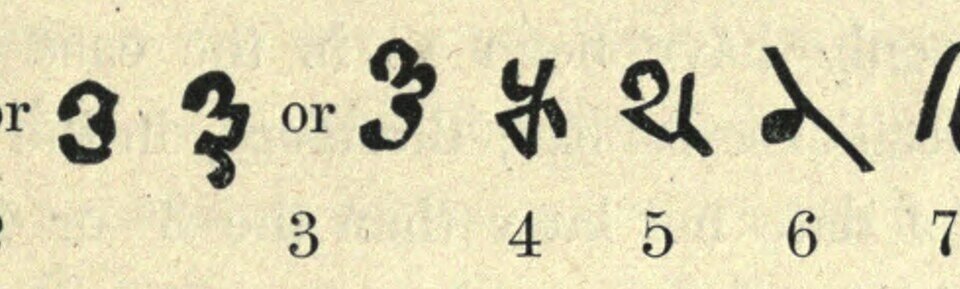
Zero feels so obvious that it is hard to see how strange it was. How can nothing be a number? Why did great civilisations with advanced mathematics manage without it? This guide follows the idea from empty spaces on Babylonian clay tablets to Brahmagupta’s rules in India, across the Arab world to Fibonacci’s Italy, and finally into the binary code inside every computer.
| Two roles | A placeholder in written numbers, and a number in its own right |
| Placeholder zeros | Babylon, the Maya and India all used them |
| Zero as a number | Developed in India; Brahmagupta’s rules, 628 CE |
| Oldest carved zero | Chaturbhuj temple, Gwalior, 876 CE |
| Reached Europe | Through Arabic works and Fibonacci, about 1200 CE |
| Today | Part of the binary system used by all computers |
| Reading time | 10 min read |
Why zero is hard
Counting begins with things you can see: three goats, five stones. Nobody counts “zero goats” except to say that there are none. So early number systems had no need for a symbol for nothing. The difficulty only appears when you want to write large numbers compactly, and need to show that a place is empty.
Roman numerals are a good example. XXIV, MMXXVI and CCC are built by adding symbols together, and a place never needs to be marked empty. This works for recording numbers but is terrible for calculating: try multiplying CLXVII by XXIII on paper. Positional systems, where the position of a digit tells you its value, make arithmetic easy, but they need a way to mark an empty place. That is what zero first did.
Try it: the place-value explorer
Type any whole number up to nine digits. The explorer breaks it into place values, shows what happens to the number if the zeros are simply dropped, and prints it in binary, the base that computers use.
Try 3007, then 307, then 37. The digits 3 and 7 are the same each time, but the number is completely different. The zeros do the work of saying “nothing in the hundreds place” and “nothing in the tens place”.
Placeholders before the number
The Babylonians wrote numbers in base 60 on clay tablets from about 2000 BCE, with a gap to show an empty place. A gap is ambiguous, so later scribes began to use a mark of two small wedges as a placeholder, from around 300 BCE. The Maya of Central America independently developed a shell-shaped zero for their calendar system. In both cases zero marked an empty position, but it was not treated as a number you could add, subtract or multiply.
India: zero becomes a number
In India the placeholder took a different path. A dot appears in the Bakhshali manuscript, a collection of mathematical text on birch bark, found in 1881 in a village near Peshawar, in what is now Pakistan. Radiocarbon dating done at the University of Oxford in 2017 showed that the manuscript’s 70 leaves come from at least three different periods, with the earliest material dating to as early as the 3rd or 4th century CE, centuries earlier than scholars had thought. In this manuscript the dot marks orders of magnitude such as tens, hundreds and thousands, a placeholder, not yet a number.
The leap to treating zero as a number is credited to Indian mathematicians. In 628 CE the astronomer-mathematician Brahmagupta, working at Bhinmal in Rajasthan, wrote the Brahmasphutasiddhanta. In it he defined zero as the result of subtracting a number from itself and set out rules: adding zero to a number leaves it unchanged, and multiplying by zero gives zero. He also dealt with negative numbers as debts. Division by zero defeated him, as it would others for centuries.
The oldest zero carved in stone is at the Chaturbhuj temple in Gwalior, in an inscription dated 876 CE, where a small circle appears as part of the number 270. Placed in a temple inscription for all to see, it shows that the symbol was in everyday use by then.
c. 300 BCE: Babylon
Scribes use a mark of two wedges as a placeholder in base-60 numbers.
3rd-4th c. CE: Bakhshali manuscript
A dot marks empty places in mathematical text from at least three periods.
628: Brahmagupta
Gives rules for calculating with zero and negative numbers in the Brahmasphutasiddhanta.
c. 820: Al-Khwarizmi
His book on Indian arithmetic spreads the digits through the Arabic-speaking world.
876: Gwalior inscription
The oldest carved zero, in a temple dedication.
1202: Fibonacci
Liber Abaci teaches Italian merchants the nine digits and the sign 0.
1299: Florence ban
The city bans the use of Arabic numerals in accounts, suspecting that digits were easy to forge.
1703: Leibniz and binary
Describes arithmetic using only 0 and 1, the basis of modern computing.
From shunya to zero
The Sanskrit word for empty or void is shunya. Arabic scholars translated it as sifr, meaning empty, which gave us both “cipher” and, through Italian zefiro and then zero, our word zero. When the Italian merchant and mathematician Leonardo of Pisa, known as Fibonacci, published Liber Abaci in 1202, he told European readers that the nine Indian figures together with the sign 0 could write any number. Adoption was slow. Some cities, including Florence in 1299, restricted the new digits in commercial records, suspecting that a 0 could be altered into a 6 or 9. But the efficiency of written arithmetic won out.
Place value in Python
n = 2026
digits = list(str(n))
for i, d in enumerate(reversed(digits)):
    print(f"10^{i}: digit {d} -> {int(d) * 10**i}")
print(bin(n))
Output:
10^0: digit 6 -> 6
10^1: digit 2 -> 20
10^2: digit 0 -> 0
10^3: digit 2 -> 2000
0b11111101010
The zero in the hundreds place contributes nothing but keeps the 2 in the thousands place. Without it, you would read 226. The last line shows the same number in binary, where every digit is a 0 or a 1.
The trouble with dividing by zero
Brahmagupta’s difficulty with division by zero is not a flaw of his era but a real puzzle. Division asks “how many times does this fit in that”. Divide 1 by smaller and smaller numbers and the answer gets bigger and bigger. Slide the divisor toward zero and watch.
There is no number you can name for “1 divided by 0”, so mathematicians leave it undefined. Calculus later made the idea of “approaching zero” precise with the idea of limits.
Zero inside every computer
Digital computers store everything as strings of 0s and 1s: numbers, text, pictures and programs. The binary system that Leibniz described in 1703 is a place-value system just like decimal, only with two digits instead of ten, so it depends on zero as much as our everyday numbers do. If you want to follow that story, read our guide to the transistor, the tiny switch that stores a 0 or a 1.
Mind map: zero at a glance
- Zero: An empty place that became a number.
- Two jobs: Placeholder and number.
- Placeholder: Marks an empty place: 1,007 vs 17.
- A number: Has its own rules: 5 + 0 = 5.
- Early placeholders: Before the number.
- Babylon: Spacing or wedge marks in base 60.
- Maya: A shell-shaped zero in the calendar system.
- Bakhshali dot: A dot in an Indian birch-bark manuscript, 3rd or 4th century or later.
- India: Where zero became a number.
- Brahmagupta, 628: Rules for working with zero.
- Gwalior, 876: Oldest known zero carved in an inscription.
- Place-value system: Ten digits, zero included.
- The journey: From India to the world.
- Arabic scholars: Al-Khwarizmi, around 820.
- Sifr to zero: Sanskrit shunya, Arabic sifr, Italian zero.
- Fibonacci, 1202: Liber Abaci introduces the digits to Europe.
- Resistance: Florence bans Arabic numerals for accounts in 1299.
- Why it matters: The idea inside everything.
- Arithmetic: Fast written calculation.
- Algebra and calculus: Zero as a boundary and a limit.
- Computers: Binary: 0 and 1.
- Two jobs: Placeholder and number.
Common myths
- Myth: Zero was invented by one person on one day. It grew through several cultures and centuries.
- Myth: The Maya and the Babylonians had zero as a number. They used it as a placeholder; treating it as a number came in India.
- Myth: Roman numerals had a zero. They did not need one, as they are not a place-value system.
- Myth: Zero is neither odd nor even. Zero is an even number, because it is divisible by two.
Key takeaways
- Zero has two jobs: marking an empty place and acting as a number.
- Indian mathematicians, notably Brahmagupta in 628 CE, wrote the rules for zero as a number.
- The system travelled through the Arab world to Europe around 1200 CE.
- Binary, the language of computers, is a place-value system that depends on zero.
Frequently asked questions
Is zero even or odd?
Even. An even number is divisible by 2 with no remainder, and 0 divided by 2 is 0.
Why do Roman numerals have no zero?
Roman numerals add up symbols and do not use place value, so there is never an empty place to mark.
Is zero a natural number?
It depends on the convention. Some textbooks start natural numbers at 1, others at 0, and computer scientists usually start at 0.
Who really invented zero?
No single person. Several cultures used placeholders, and Indian mathematicians turned zero into a number with rules.
Keep exploring
The switch that stores 0 and 1.Artificial intelligence
Computing built on binary numbers.Mind map of all inventions
See the whole story in one map.
Sources
- Zero (mathematics), Encyclopaedia Britannica
- Indian mathematics, Encyclopaedia Britannica
- Brahma-sphuta-siddhanta, Encyclopaedia Britannica
- Carbon dating finds Bakhshali manuscript contains oldest recorded origins of the symbol zero, University of Oxford, Bodleian Libraries
- Chaturbhuj Temple, Gwalior, Wikipedia
Featured image: Image: Augustus Hoernle (1841-1918), via Wikimedia Commons, Public domain. Dates for early events are approximate.


1 Comment
[…] Billions of such gates, arranged into adders, memory cells and processors, make up a computer. The binary logic of 0 and 1 also depends on the idea of zero as a number. […]