

How Steam Power Built the Modern World: From Flooded Mines to India’s First Train


Almost every machine you use today traces back to one stubborn problem: how do you get useful work out of fire? This guide walks through the answer in the order engineers actually discovered it. We start in a flooded English coal mine, follow the steam engine as it becomes more efficient, put it on rails, and finish on the platform where India’s first passenger train left in 1853. Along the way there is a calculator you can play with and a short Python script that measures how wasteful the first engines really were.
| Problem solved | Pumping floodwater out of deep coal and tin mines |
| First practical engine | Thomas Newcomen, 1712, Dudley Castle, England |
| Big upgrade | James Watt’s separate condenser (conceived 1765, patented 1769) |
| First steam locomotive run | Richard Trevithick, Wales, 1804 |
| India’s first passenger train | 16 April 1853, Bombay (Bori Bunder) to Thane, 34 km |
| Reading time | About 15 minutes |
The problem: water in the mines
By the early 1700s Britain was burning more coal than anyone before it, for heating homes and for smelting metal. The easy coal near the surface was running out, so miners dug deeper. Deeper shafts hit groundwater, and a flooded mine produces nothing. Horses turning pumps worked, but a large mine could need dozens of them, and feeding horses was expensive.
The idea that unlocked the problem is atmospheric pressure. Air presses on everything at about 101,000 pascals at sea level. If you remove the air from one side of a piston, the atmosphere pushes the piston in for free. The trick is to remove the air cheaply, and steam can do that: fill a cylinder with steam, cool it, and the steam collapses back into a few drops of water, leaving a partial vacuum.
Thomas Savery patented a pump on this principle in 1698. It had no piston and no moving parts to speak of, but it could not lift water far, and its high-pressure vessels were dangerous. The field was open for a better design.
Step 1: Newcomen’s atmospheric engine
Thomas Newcomen, an ironmonger from Dartmouth in Devon, combined the pieces into a working machine. His first successful engine was installed to pump a mine at Dudley Castle in Staffordshire in 1712. It is usually called the first practical steam engine, and it stayed in service for most of the next century.
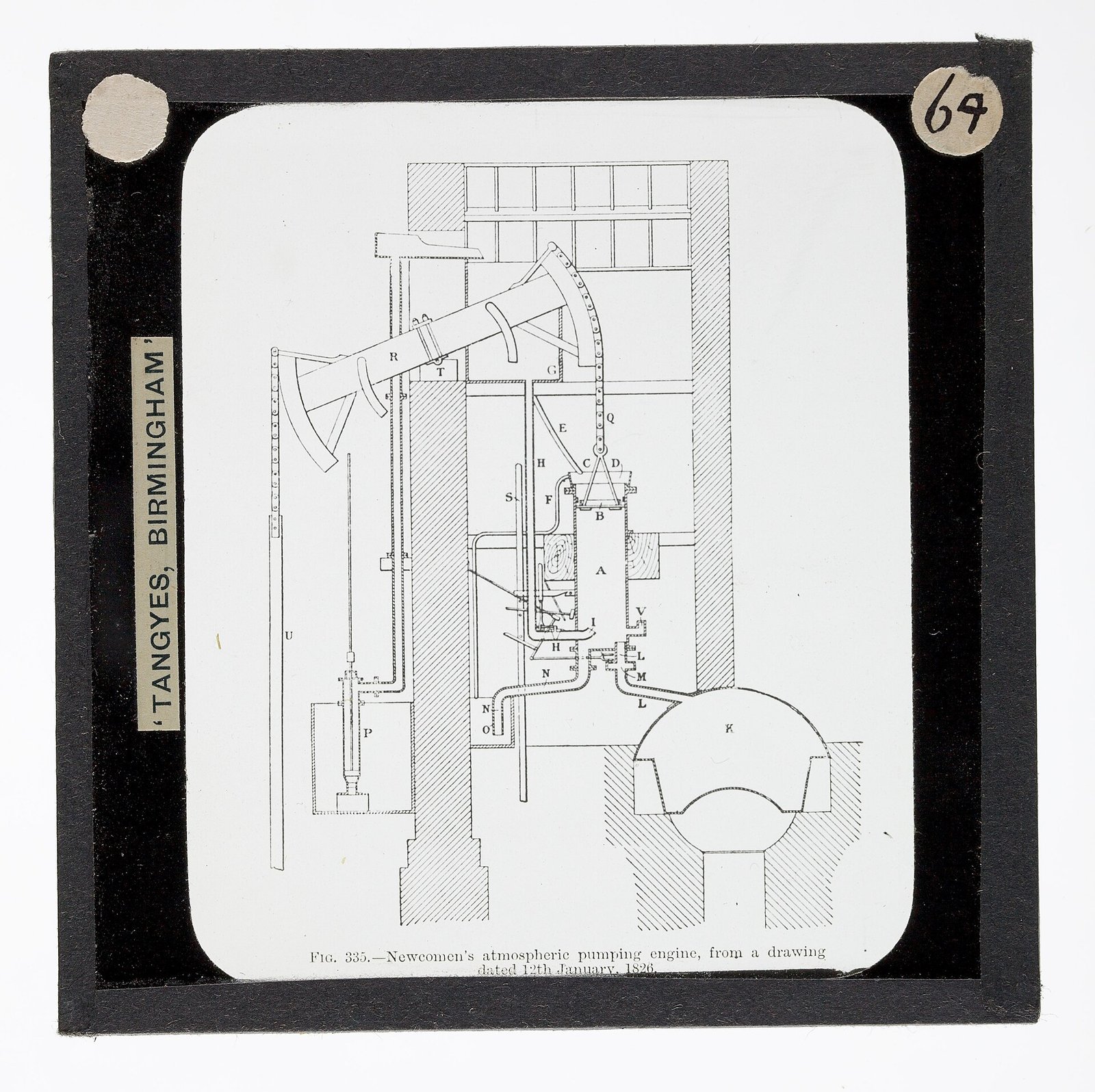
How one stroke works
- Steam in. The boiler sends low-pressure steam into the cylinder. The weight of the pump rod on the far end of the beam pulls the piston to the top.
- Spray. A jet of cold water is sprayed into the cylinder. The steam condenses, and the pressure inside drops far below the air outside.
- Power stroke. The atmosphere pushes the piston down. The beam rocks and the pump rod on the other end lifts water out of the mine.
- Reset. The condensed water drains out, steam enters again, and the cycle repeats, roughly a dozen times a minute.
Notice what is doing the work. Steam does not push the piston; the atmosphere does. Steam is only the tool that creates the vacuum. That is why the engine is called atmospheric.
There was one big flaw. Every cycle the cylinder was heated by fresh steam and then chilled by cold water, so most of the coal’s heat went into warming iron that was about to be cooled again. At a colliery that had its own coal this hardly mattered. Anywhere coal had to be bought and carried, the engine was ruinously hungry.
Step 2: Watt’s separate condenser
In the 1760s James Watt, an instrument maker at the University of Glasgow, was asked to repair a model Newcomen engine. He noticed how much steam it swallowed just to reheat its own cylinder. His fix came in 1765: let the cylinder stay hot all the time, and condense the steam in a second, cold chamber connected by a valve. The patent followed in 1769.
A good everyday comparison is a hot drink in a flask. If you pour the drink out, chill the flask, then refill it for every cup, you waste the heat. Keep the flask hot and cool the drink somewhere else, and you save almost all of it. Commonly cited figures say Watt’s engines used roughly a quarter of the coal of a comparable Newcomen engine for the same work.

Watt then partnered with the Birmingham manufacturer Matthew Boulton, whose workshops could build parts accurately enough to make the idea work. Over the next two decades the firm added the sun-and-planet gear (1781) to turn the beam’s rocking into rotation, double-acting cylinders (1782), the parallel-motion linkage (1784) and the centrifugal governor (1788), which keeps speed steady automatically. With rotation, the engine could now drive mills, looms and forges, not just pumps. This is the point where the Industrial Revolution gets its engine.
Try it: the coal calculator
Engineers of the time measured an engine by its duty: how many foot-pounds of work it did for each bushel of coal. Here are rounded duty figures for four generations. Slide the work needed and watch what happens to the coal bill.
Drag the slider to set how much pumping work a mine needs. The bars show the coal each engine generation needed, using the rounded historical duty figures explained below.
Approximate teaching figures, not lab measurements. One bushel is taken as 84 lb (about 38 kg) of coal.
Under the hood: efficiency in Python
The calculator hides a simple conversion. A bushel of coal holds a known amount of heat. The duty tells you how much of that heat became useful work. Dividing one by the other gives thermal efficiency. Here is the whole calculation, so you can run it and change the numbers.
# How efficient were early steam engines?
# "Duty" = foot-pounds of work done per bushel (84 lb) of coal burned.
COAL_BTU_PER_LB = 12_000      # typical bituminous coal, approximate
FT_LB_PER_BTU   = 778.17      # mechanical equivalent of heat
BUSHEL_LB       = 84

energy_per_bushel = BUSHEL_LB * COAL_BTU_PER_LB * FT_LB_PER_BTU   # ft-lb of heat

engines = {
    "Newcomen (c.1720s)":       5_000_000,
    "Smeaton Newcomen (1770s)": 9_500_000,
    "Watt (c.1780s)":          25_000_000,
    "Cornish (c.1830s)":       70_000_000,
}

print(f"{'Engine':26} {'Duty (ft-lb)':>14} {'Efficiency':>11}")
for name, duty in engines.items():
    eff = duty / energy_per_bushel * 100
    print(f"{name:26} {duty:14,} {eff:10.2f}%")

def carnot(t_hot_c, t_cold_c):
    return (1 - (t_cold_c + 273.15) / (t_hot_c + 273.15)) * 100

print()
print(f"Carnot limit, steam 100C / condenser 30C : {carnot(100, 30):.1f}%")
print(f"Carnot limit, steam 152C / condenser 40C : {carnot(152, 40):.1f}%")
Running it prints:
Engine                       Duty (ft-lb)  Efficiency
Newcomen (c.1720s)              5,000,000      0.64%
Smeaton Newcomen (1770s)        9,500,000      1.21%
Watt (c.1780s)                 25,000,000      3.19%
Cornish (c.1830s)              70,000,000      8.92%

Carnot limit, steam 100C / condenser 30C : 18.8%
Carnot limit, steam 152C / condenser 40C : 26.3%
The first engines turned well under one percent of the coal’s heat into work. Even Watt’s engine managed only about three percent. Is that a failure? Not quite. The second law of thermodynamics, worked out by Sadi Carnot in 1824 while studying exactly these engines, says no engine can beat the limit set by its temperatures:
efficiency_max = 1 - T_cold / T_hot # temperatures in kelvinWith steam at 100 degrees C and a 30 degree C condenser, the ceiling is only about 19 percent, however clever the design. The way to raise the ceiling is to raise the steam temperature, which means raising the pressure. That is the next step.
Step 3: High-pressure steam
Watt distrusted high-pressure steam, partly because boilers of the day could burst. But Richard Trevithick, a Cornish engineer, reasoned that steam at several times atmospheric pressure could push a piston directly, with no vacuum and no condenser at all. Such an engine could be small and light because it did not need a giant cylinder to catch the weight of the air.
Light engines can move themselves. In 1804 Trevithick’s locomotive hauled ten tons of iron, 70 men and five wagons along a tramway at the Penydarren ironworks in South Wales. It cracked the cast-iron rails and was not repeated commercially, but it proved the idea. Meanwhile, Cornish mine engines using higher pressures became the most efficient engines of the early 19th century, which is why the last row of our table is labelled Cornish.
Step 4: Steam meets rails
Locomotives needed three things to become a business: reliable engines, rails strong enough to carry them, and a customer. George Stephenson supplied the first and, with his son Robert, much of the second. The customers were colliery owners and, soon after, passengers.
- 1825: The Stockton and Darlington Railway in north-east England opened, with Stephenson’s Locomotion No. 1 hauling the first public steam-hauled trains.
- 1829: Trials were held at Rainhill, near Liverpool, to choose an engine for the new Liverpool and Manchester Railway. Stephenson’s Rocket won.
- 1830: The Liverpool and Manchester Railway opened. It ran to a timetable, carried passengers and goods, and used only steam locomotives. Many historians treat it as the first modern railway.
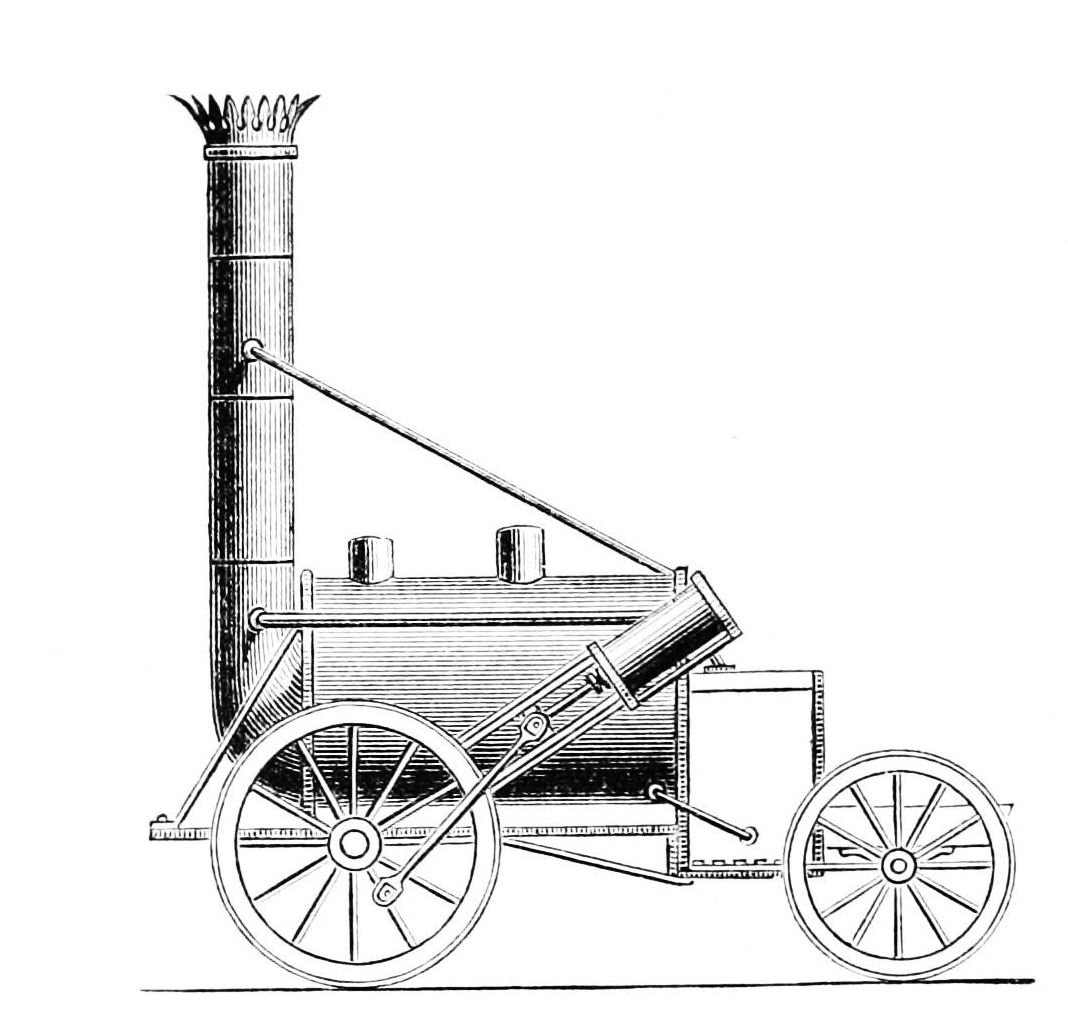
The Rocket worked because of two features. A multi-tube boiler passed hot gases through many small tubes surrounded by water, which heats water much faster than one big flue. And exhaust steam was sent up the chimney, which pulled air through the fire and made it burn hotter the faster the engine ran. Together they gave the Rocket speed with a small, light boiler. Within a few years, railway mania had begun.
| Year | Who | What changed |
|---|---|---|
| 1698 | Thomas Savery | Patents a steam-driven water pump with no piston |
| 1712 | Thomas Newcomen | First practical piston engine, at Dudley Castle |
| 1765-69 | James Watt | Separate condenser conceived, then patented |
| 1781-88 | Watt and Boulton | Rotary motion, double action, centrifugal governor |
| 1804 | Richard Trevithick | High-pressure steam locomotive hauls iron on rails in Wales |
| 1825 | George Stephenson | Stockton and Darlington Railway opens |
| 1829-30 | Stephensons | Rocket wins Rainhill; Liverpool and Manchester Railway opens |
| 1853 | GIP Railway | India’s first passenger train, Bombay to Thane |
India’s first train
Railways reached India remarkably fast. Governor-General Lord Dalhousie wrote his famous railway minute in 1853, setting out a plan for trunk lines linking the major ports and cities. The Great Indian Peninsula Railway (GIPR) had already built its first short section from Bombay, and on 16 April 1853 the first passenger train in India left Bori Bunder in Bombay for Thane.
- Distance: about 34 km (21 miles).
- Train: 14 carriages hauled by three steam locomotives named Sahib, Sindh and Sultan.
- Passengers: roughly 400 invited guests.
- Operator: the Great Indian Peninsula Railway.
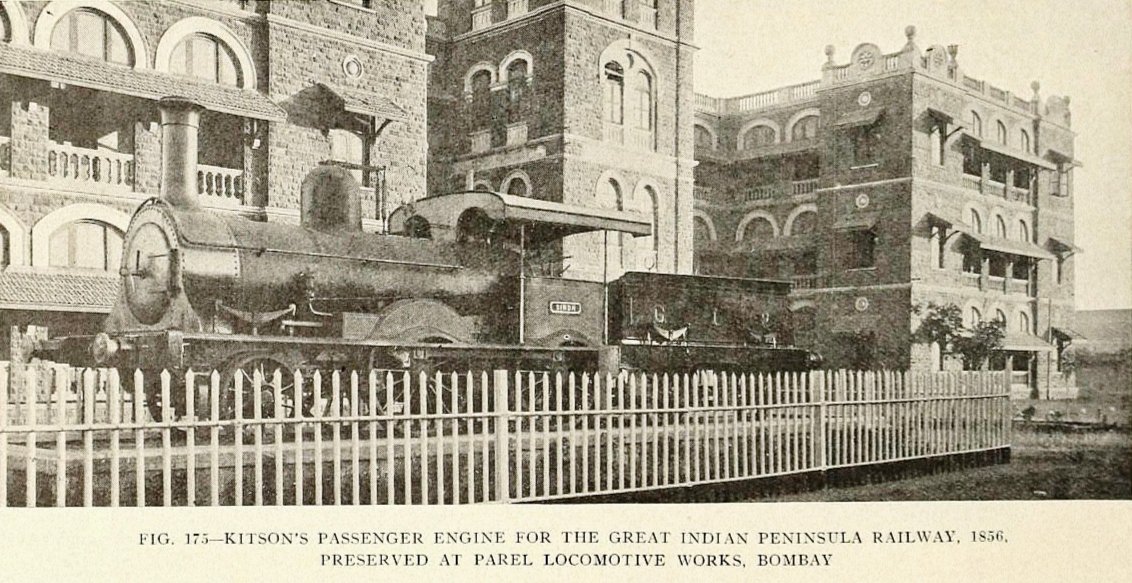
More lines followed quickly: Howrah to Hooghly in eastern India in 1854, and Madras (Royapuram) to Wallajah Road in 1856. By the end of the century India had a dense network. It is worth keeping two ideas in your head. The railways connected people and markets and later became a cornerstone of the independent nation. They were also built to serve colonial trade, carrying raw materials such as cotton to ports. Historians continue to debate the balance of the two.
Some of the most striking lines are the hill railways. The Darjeeling Himalayan Railway, the Nilgiri Mountain Railway and the Kalka-Shimla Railway together form UNESCO’s Mountain Railways of India World Heritage Site, and several still run steam locomotives for visitors. They are living museums of the exact technology in this article.
Common myths
- Myth: Watt invented the steam engine. He transformed it; Savery and Newcomen came first.
- Myth: Steam pushed Newcomen’s piston. The atmosphere did.
- Myth: Stephenson invented the locomotive. Trevithick ran one in 1804; Stephenson made the railway system practical.
- Myth: Early engines were just inefficient and nothing else mattered. A one percent engine was still cheaper than hundreds of horses at a pit with free coal.
Key takeaways and FAQ
- Each major step in steam power was a response to one concrete waste: a flooded mine, a reheated cylinder, a heavy engine.
- Efficiency of heat engines is capped by temperature. Higher pressure means higher temperature, which means a higher ceiling.
- Engines on rails changed distance into time. India’s first train covered 34 km in about an hour, a trip that took far longer by road in 1853.
Did James Watt invent the steam engine?
No. Savery and Newcomen built working steam-powered pumps decades earlier. Watt’s great contribution was a far more efficient design and the machinery to turn it into rotary power.
Why did the first engines pump water instead of moving trains?
Early engines were huge, heavy and made only a slow up-and-down stroke. Mines needed exactly that kind of motion and had cheap coal at the pit head, so pumping paid for itself first.
What does “high pressure” actually buy you?
More power from a smaller, lighter engine. That is what made it possible to put an engine on wheels.
Which Indian railways are UNESCO World Heritage?
The Mountain Railways of India: the Darjeeling Himalayan Railway, the Nilgiri Mountain Railway and the Kalka-Shimla Railway.
Want to keep going? Read about the wheel, the oldest idea that railways still depend on, or jump forward to the electric car to see what replaced steam on the road.
Mind map: the steam story
- Steam power
- Problem
- Flooded mines
- Horses too slow
- Wood running short
- Engines
- Newcomen 1712
- Watt condenser
- Boulton and Watt
- High pressure
- Railways
- Stephenson Rocket
- Liverpool and Manchester
- Global spread
- India
- First train 1853
- Bombay to Thane
- Coal and rail network
- Effects
- Factories
- Cities
- Coal and carbon
- Problem
Sources
- Thomas Newcomen, Encyclopaedia Britannica
- Steam engine, Encyclopaedia Britannica
- James Watt, Encyclopaedia Britannica
- Richard Trevithick, Encyclopaedia Britannica
- Watt’s second separate condenser, 1765, Science Museum Group
- Atmospheric engine by John Smeaton, 1772, Science Museum Group
- The first passenger train in India, 16 April 1853, Ministry of Railways, Government of India
- Mountain Railways of India, UNESCO World Heritage Centre
Duty and efficiency figures are rounded historical estimates used for teaching. Featured image: Boulton and Watt engine, Newtown grafitti from Sydney, Australia, via Wikimedia Commons, CC BY 2.0.


2 Comments
[…] is a wheel with teeth. Clocks, mills, bicycles, turbines and engines all depend on wheels. In a steam engine, a heavy flywheel smooths out power from the pistons, and railways are in essence a very […]
[…] solar cellClean power for charging.How steam power built the modern worldAnother power revolution on wheels.The wheelWhere it all […]