

The First Photograph: How Light Was Captured on Metal

A photograph is a record of light. Before 1826 there was no way to keep a picture of a real scene without drawing it. Then a French inventor left a pewter plate in a box for hours, washed it, and held in his hands the oldest surviving photograph. This guide follows photography from that plate to the phone in your pocket, lets you play with exposure like a photographer, and tells the story of Raja Deen Dayal, the photographer who documented India for the Nizam and the Viceroy.
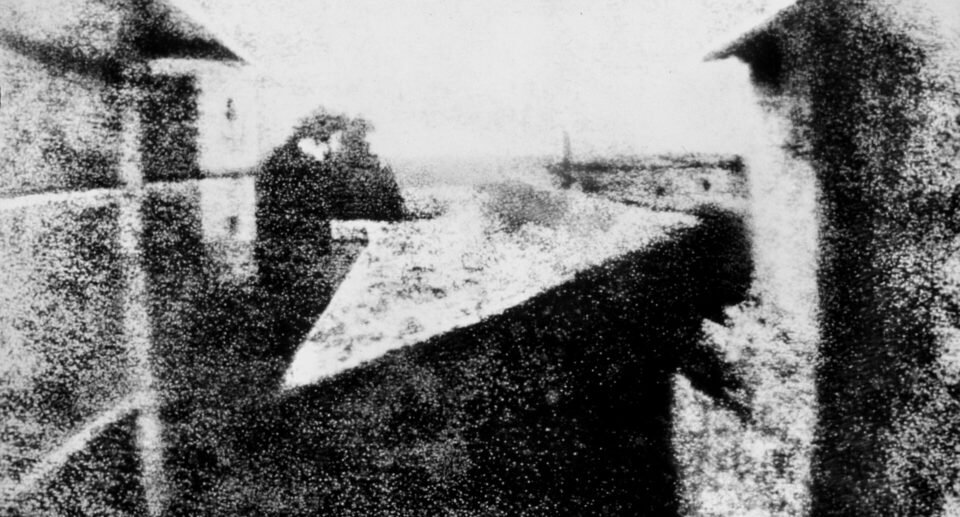
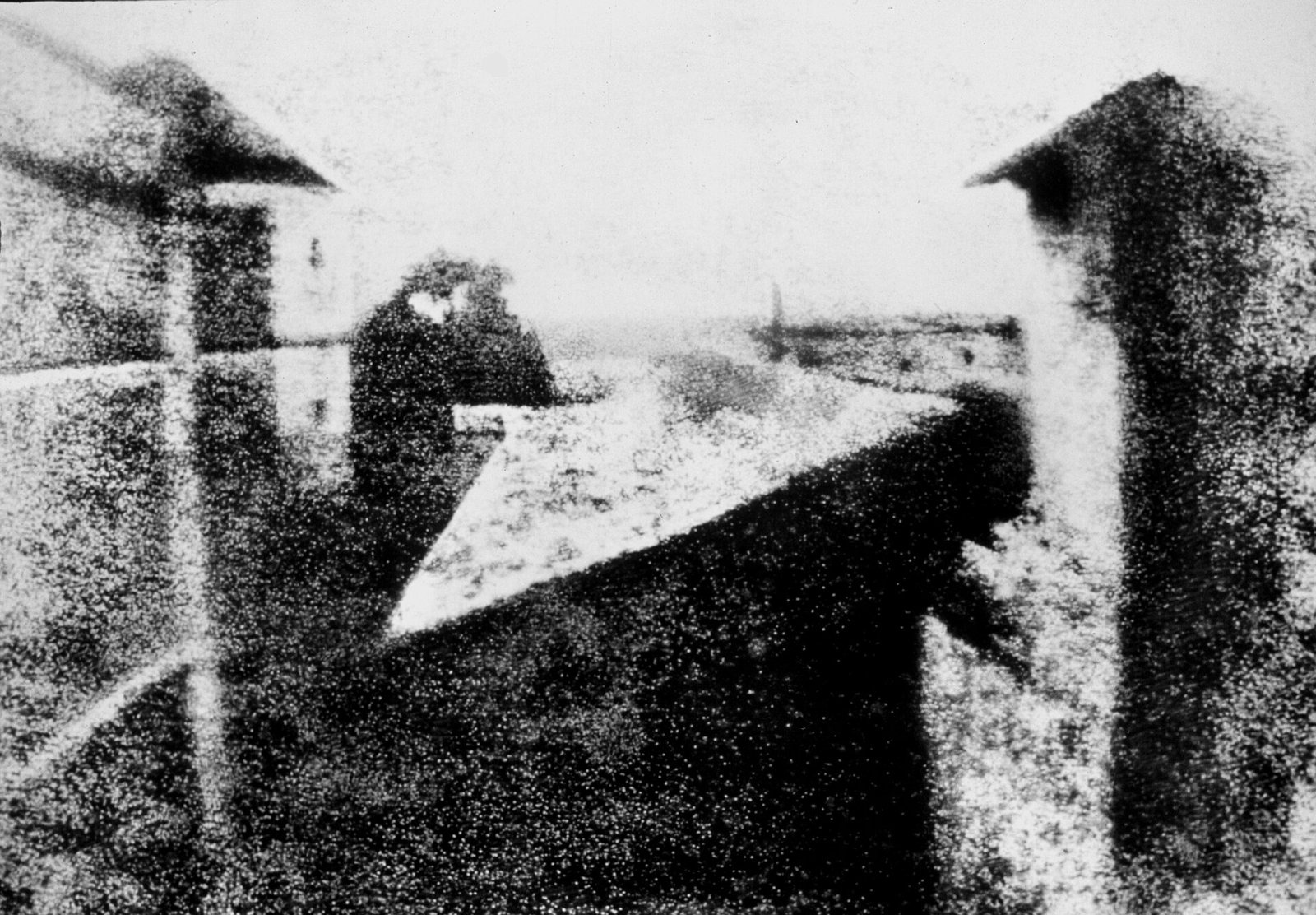
| First photograph | View from the Window at Le Gras, Joseph Nicéphore Niépce, 1827 |
| First public process | Daguerreotype, announced in 1839 |
| Negative and positive | William Henry Fox Talbot, early 1840s |
| Mass market | Kodak camera, 1888 |
| Digital | Steven Sasson at Kodak, 1975 |
| Reading time | 10 min read |
The idea: a dark room with a tiny hole
The camera obscura (“dark chamber”) is older than photography by many centuries. Light from a bright scene passes through a small hole in the wall of a dark room, and an upside-down image of the scene appears on the opposite wall. Scholars in the Islamic world, including Ibn al-Haytham around the year 1000, studied it carefully, and artists later used it to trace scenes.
What was missing was a material that could record that image by itself. The problem was chemistry, not optics.
Niépce and the first photograph
Joseph Nicéphore Niépce developed a process he called heliography (“sun writing”). In 1827, at his family estate Le Gras in Saint-Loup-de-Varennes, he put a pewter plate coated with bitumen of Judea, a light-sensitive asphalt, in a camera obscura facing his window. Light hardened the bitumen where it fell. The soft, unhardened areas were then washed away with a mix of lavender oil and white petroleum.
The result, View from the Window at Le Gras, is the oldest surviving photograph from nature. The traditional estimate is that the exposure took about eight hours, which is why sunlight seems to fall on buildings on both sides. A modern researcher who rebuilt the process believes it may have taken several days. The plate was nearly forgotten until historians Helmut and Alison Gernsheim found it again in 1952. Today it is kept at the Harry Ransom Center in Texas.
Daguerre, Talbot and the race to improve
Niépce partnered with Louis Daguerre, a painter and showman. After Niépce died in 1833, Daguerre found a far faster method, the daguerreotype: a silver-coated copper plate that records a sharp image in minutes. It was announced in Paris in 1839, and the French state bought the rights and gave the process to the world for free, except in Britain where it was patented.
In England, William Henry Fox Talbot invented a different idea: make a paper negative first and then print many positives from it. The daguerreotype gave one beautiful image. Talbot’s approach gave unlimited copies, and that negative-positive idea ran photography for the next 150 years.
1. Light-sensitive surface
A plate or paper is coated with a chemical that changes when light hits it.
2. Exposure
The plate sits inside a camera for seconds, minutes or hours, depending on the process and the light.
3. Development
Chemicals bring out the invisible (latent) image on the plate.
4. Fixing
Another treatment removes the remaining sensitive material so the picture does not turn black in daylight.
5. Print or display
A daguerreotype is displayed as is. A negative is used to print as many positives as needed.
Try it: be the photographer
Every photograph balances three controls: aperture (the size of the lens opening), shutter speed (how long light is let in) and ISO (how sensitive the sensor or film is). Pick a scene and adjust them. The meter tells you how many stops too bright or too dark the picture would be. One “stop” means double or half the light.
The meter uses a standard rule from photography. Exposure value is the base-2 logarithm of the aperture number squared divided by the shutter time. Here the same sums are done in Python. I ran the code, and the output is real.
EV = 15  # bright sunny day, ISO 100
for N in (2, 4, 8, 16):
    t = N**2 / 2**EV
    print(f"f/{N:<3} -> 1/{round(1/t):>5} s")
f/2 -> 1/ 8192 s
f/4 -> 1/ 2048 s
f/8 -> 1/ 512 s
f/16 -> 1/ 128 sLook at what Niépce faced: eight hours is 28,800 seconds. Compared with a modern shutter of 1/125 s, his plate needed about 22 stops more light-gathering time. That gap is why early portraits needed sitters to stay still with head clamps.
From plates to roll film to phones
1827: Niépce’s heliograph
The first surviving photograph from nature.
1839: The daguerreotype is announced
Sharp one-off images on silver-coated plates.
1888: George Eastman’s Kodak
A simple box camera with roll film, sold with the line “You press the button, we do the rest”.
1975: The first digital camera
Steven Sasson at Kodak builds a prototype of about 3.6 kg that records a 100 x 100 pixel image in around 23 seconds onto tape.
2007: Phones become cameras
The smartphone era makes photography part of everyday life.
Eastman’s idea was to take the difficult chemistry away from the photographer. After 1888, ordinary families, not only experts, could take a picture. The digital sensor was another leap: instead of silver chemicals the image becomes numbers, which can be copied, edited and sent at no cost.
India and photography
Photography reached India within a year or two of its announcement, and by the 1850s photographic societies existed in Bombay, Calcutta and Madras. The British administration used photographs for surveys of buildings, people and landscapes, and Indian and British photographers both worked widely.
The best-known Indian photographer is Lala Deen Dayal (born around 1844, died 1905). He trained as an engineer at Roorkee, began taking pictures in Indore and became the court photographer to the Nizam of Hyderabad in 1885, who gave him the title Raja. He was also appointed photographer to the Viceroy, opened studios in Secunderabad (1886) and Bombay (1896), and received a royal warrant from Queen Victoria in 1897. His portfolio Famous Monuments of Central India has 86 photographs. A collection of 2,857 of his glass plate negatives is held today by the Indira Gandhi National Centre for the Arts in New Delhi.
His pictures of monuments, ceremonies and the 1870s famine are some of the best visual records of 19th-century India, and they show how photography became both art and evidence.
Mind map: photography
- Photography
- Before
- Camera obscura: dark room, small hole
- Ibn al-Haytham: optics
- Chemistry problem
- Early processes
- Heliograph: Niépce 1827
- Daguerreotype: 1839
- Calotype: Talbot
- Mass market
- Roll film
- Kodak: 1888
- Colour film
- Digital
- Sasson 1975
- Sensors
- Smartphones
- India
- Photographic societies: 1850s
- Lala Deen Dayal: 1844 to 1905
- IGNCA archive
- Before
Myths worth correcting
- Myth: Daguerre invented photography alone. Fact: Niépce made the first surviving photograph, and Talbot invented the negative.
- Myth: Old photos have people staring because they were grim. Fact: long exposures made smiling hard to hold.
- Myth: Digital photography is new. Fact: the first prototype is from 1975.
Key takeaways
- Photography is recorded light, first achieved by Niépce in 1827 with a pewter plate and bitumen.
- Daguerre gave sharp one-off pictures, and Talbot’s negative gave copies.
- Kodak made photography an everyday habit in 1888.
- The first digital camera, in 1975, made only a 100 x 100 pixel image.
- Lala Deen Dayal is a key figure in Indian photography.
Frequently asked questions
Who took the first photograph?
Joseph Nicéphore Niépce, in 1827, though some dating suggests 1826. The image survives.
Why did early photos need such long exposures?
The chemicals were not very sensitive to light, so the plate needed a lot of it.
What is a daguerreotype?
A one-off image on a polished silver-coated copper plate.
Who was Raja Deen Dayal?
One of India’s most famous 19th-century photographers, court photographer to the Nizam of Hyderabad.
Keep reading
The camera most people use today.The Transistor
The part inside every digital sensor.Paper
The material of Talbot’s first negatives.Mind Map hub
Where photography fits in the big picture.
Sources
- Photography, Encyclopaedia Britannica, overview of the history
- View from the Window at Le Gras, Wikipedia, date, process and rediscovery
- Lala Deen Dayal, Wikipedia, career and studios
- Steven Sasson, Wikipedia, first digital camera details
Facts were cross-checked and rewritten in our own words.



1 Comment
[…] Camera: Phones replace compact cameras. […]