

The Wheel: 5,500 Years of the World’s Most Important Invention

Ask anyone for the greatest invention in history and the wheel will come up. Yet the wheel’s real story is stranger than “someone invented a circle”. For most of human history people did without it, the earliest wheels were clumsy slabs of wood, and the hardest part was not the wheel at all. This guide explains how the wheel works, why it took so long to appear, how it changed, and where it turns up in Indian history and symbols.
| What it is | A circular body that rotates on an axle |
| Earliest evidence | Mesopotamia, around 3500 BCE (potter’s wheels and vehicles) |
| Oldest surviving wheel with axle | Ljubljana Marshes, Slovenia, about 3150 BCE |
| Big improvements | Spokes, around 2000 BCE; iron tyres; rubber tyres in the 1800s |
| In India | Indus carts, the Ashoka Chakra and the chariot wheels of Konark |
| Reading time | 10 min read |
Before the wheel
For most of prehistory, moving a heavy load meant carrying it, dragging it, or both. People used sledges, which are simple wooden platforms pulled over the ground, and later laid logs underneath to roll loads along. Rollers are a clue to the invention: a log under a heavy block turns, and the block moves forward with far less effort than when it slides.
But rollers are awkward. As the load moves forward, the log at the back is freed and has to be carried to the front again. A wheel solves this by fixing the “roller” under the load, leaving only the thin axle to turn.
The idea that changes everything: rolling beats sliding
Sliding creates friction across the whole surface of contact. Rolling replaces that with rolling resistance, which is usually far smaller. Engineers describe the force needed to move a load with a simple formula: force = coefficient × weight. For a sledge the coefficient is sliding friction, and for a wheel it is rolling resistance. Both depend on the ground.
Illustrative coefficients, not lab values. A person can pull about 150 newtons for a long time.
Try the extremes. On a smooth road the wheel wins massively; on soft sand its advantage shrinks because the wheel sinks in. That is why early wheeled carts were most useful on firm, prepared ground, and why roads were such a big deal in ancient empires.
Wheel physics in Python
g = 9.81                      # m/s^2
mass = 500                    # kg
weight = mass * g             # newtons

mu_sledge = 0.5               # packed earth, dry
mu_wheel = 0.02               # wheel rolling on firm ground
person_pull = 150             # newtons a person can sustain

for name, mu in [("Sledge", mu_sledge), ("Wheeled cart", mu_wheel)]:
    force = mu * weight
    people = -(-force // person_pull)   # round up
    print(f"{name:13} needs {force:7.1f} N  ({people:.0f} people pulling)")
Output:
Sledge        needs  2452.5 N  (17 people pulling)
Wheeled cart  needs    98.1 N  (1 people pulling)
For a half-tonne load, a person can easily pull a wheeled cart on firm ground, while the sledge needs a team. These coefficients are simplified, but the ratio shows why the wheel spread so widely.
The first wheels
The earliest evidence for wheels appears in the 4th millennium BCE. In Mesopotamia a potter’s wheel, a turntable used to shape clay, was in use by around 3500 BCE, and a Sumerian picture from Uruk shows a sledge on wheels. In Europe a pot from Bronocice in Poland, dated to about 3500 to 3350 BCE, is decorated with what looks like a four-wheeled wagon. The oldest wooden wheel with its axle ever found, the Ljubljana Marshes Wheel, was found in Slovenia and dates to around 3150 BCE.
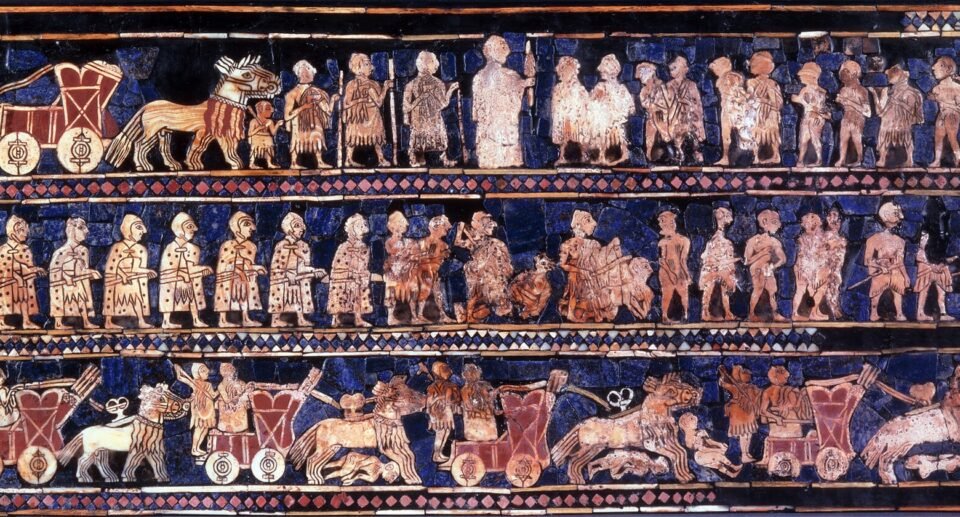
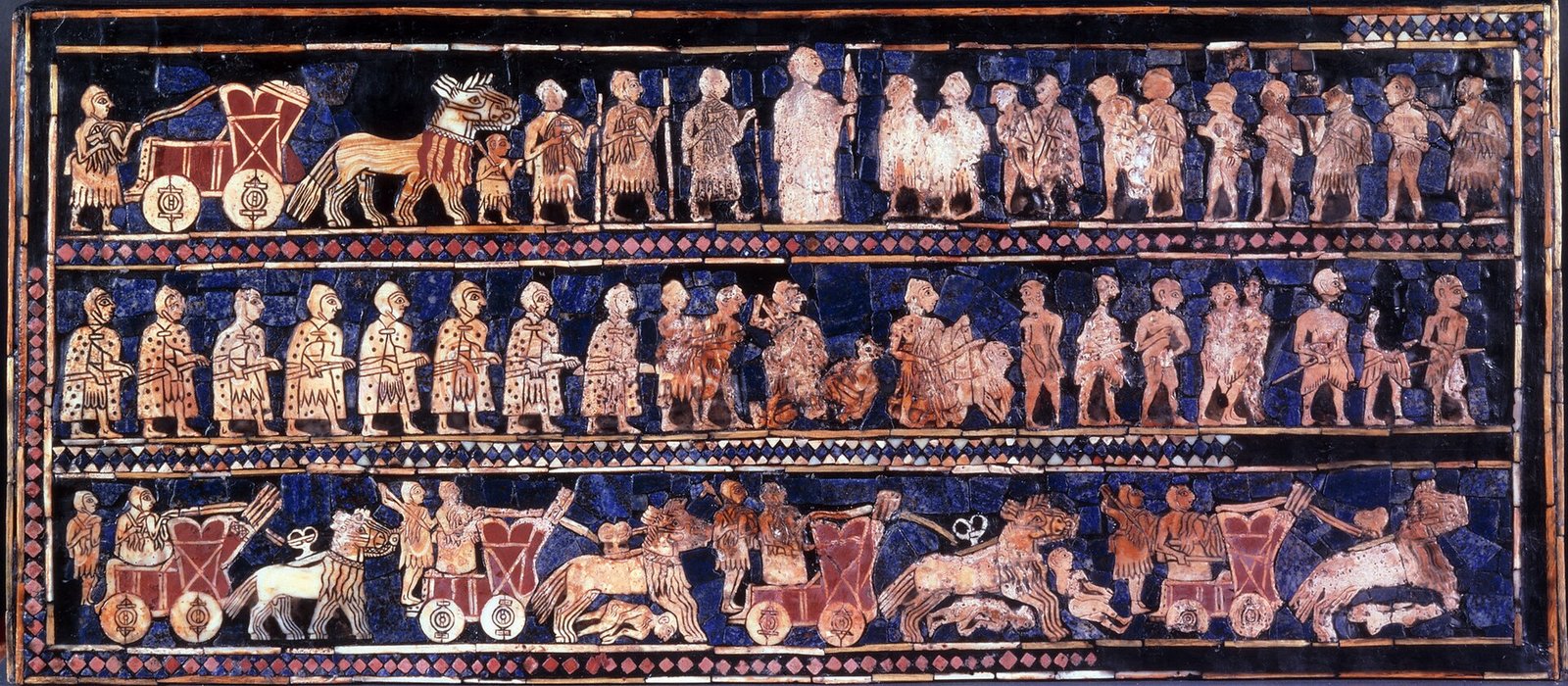
Those earliest wheels were not spoked. They were solid discs made of planks joined by wooden struts, as Britannica describes. The Standard of Ur, a Sumerian artwork from around 2600 BCE, shows war carts with such wheels pulled by animals.
Archaeologists do not agree on which came first. The two seem to appear at about the same time in the fourth millennium BCE, and each may have inspired the other. The safe conclusion is that the wheel was a gradual development, not a single flash of invention.
The axle problem
Making a round disc is easy. The hard part is mounting it. If the wheel is fixed to the axle, the axle turns with it, and the load must hang on bearings. If the wheel turns on a fixed axle, the hole in the wheel must fit the axle tightly enough to avoid wobble but loosely enough to turn. With wood and stone tools, getting those tolerances right was difficult. A wheel that wobbles breaks, and a hub that sticks wears out. Greasing the axle with animal fat helped, and later metal fittings made the fit better.
Cut matching discs
Planks are cut and joined into a round disc, and the centre hole is drilled for the axle.
Fit the axle
The axle is shaped to fit the hub. A tight fit stops wobble but needs grease or the hub burns.
Add a rim
A rim, later of iron, protects the wood from wear and keeps the shape.
Lighten the wheel
Cutting away the disc and adding spokes around 2000 BCE made wheels lighter and chariots fast.
Cushion the ride
Rubber and later pneumatic tyres soften the ride and cut road damage.
From plank to pneumatic tyre
c. 3500 BCE: First wheels
Potter’s wheels in Mesopotamia and wheeled vehicles in Mesopotamia and Europe.
c. 3150 BCE: Ljubljana Marshes Wheel
The oldest known wooden wheel with an axle, found in Slovenia.
c. 2600 BCE: Standard of Ur
A Sumerian artwork showing war carts with solid wheels.
c. 2000 BCE: Spoked wheels
Lighter spoked wheels appear on chariots, which become fast fighting machines.
c. 250 BCE: Ashoka’s lion capital
The Sarnath pillar carries a wheel with 24 spokes, a symbol later placed on India’s flag.
13th c. CE: Konark Sun Temple
King Narasimhadeva I builds a temple shaped like a chariot with 24 wheels.
1794: Ball bearings
Philip Vaughan patents a ball bearing for carriage axles.
1808: Tension spokes
George Cayley designs a wheel whose wire spokes work in tension, the basis of bicycle wheels.
1839: Vulcanised rubber
Charles Goodyear’s process makes rubber strong and elastic.
1888: Pneumatic tyre
John Boyd Dunlop patents an air-filled tyre for his son’s tricycle.
The wheel as a machine part
The wheel did not stay on carts. A water wheel turns a river’s flow into rotation, a spinning wheel makes thread, a pulley wheel lifts loads, and a gear is a wheel with teeth. Clocks, mills, bicycles, turbines and engines all depend on wheels. In a steam engine, a heavy flywheel smooths out power from the pistons, and railways are in essence a very low-friction wheel on a very smooth rail.
The wheel in India
Wheeled vehicles were part of the Indus Valley civilisation. Archaeologists have found terracotta toy carts, cart wheels and bronze models at Harappan sites, which show that carts were familiar in the third millennium BCE. Reports of chariot remains at Sinauli in Uttar Pradesh and a bronze chariot model at Daimabad in Maharashtra have drawn attention, but dating of such finds is debated, so treat dates there with caution.
In a more famous example, the wheel became a symbol. The Lion Capital of Ashoka at Sarnath, from around the 3rd century BCE, stands on a base showing a wheel, the dharmachakra, with 24 spokes. That wheel appears at the centre of the national flag of India, adopted in 1947. On the 13th-century Sun Temple at Konark in Odisha, built under King Narasimhadeva I, the whole temple is designed as the sun god’s chariot, with 24 carved stone wheels, twelve pairs. Those wheels double as sundials, and UNESCO lists the temple as a World Heritage Site.
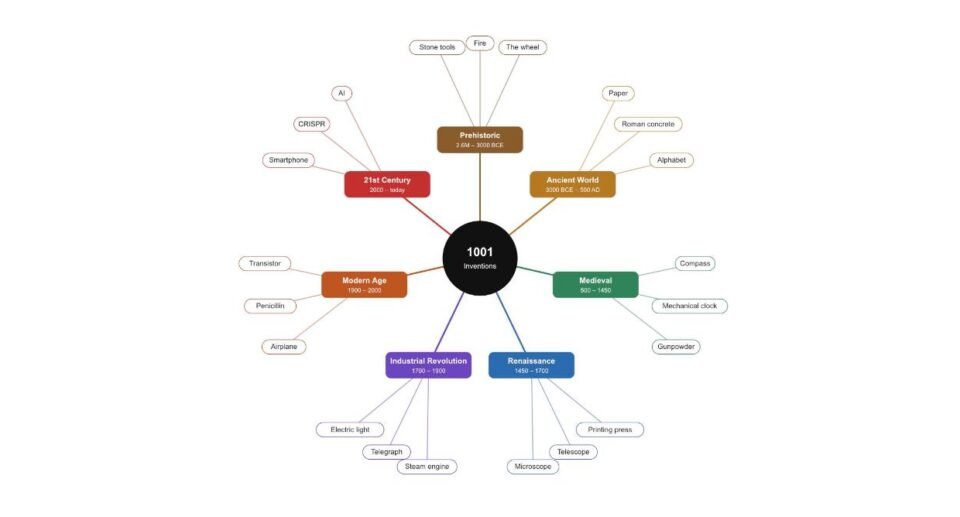
Mind map: the wheel at a glance
- The wheel: A simple circle that reshaped transport, industry and symbols.
- Before the wheel: Moving heavy things the hard way.
- Carrying: Limited by what a person or animal can lift.
- Sledges: Dragged over ground, with high friction.
- Log rollers: Logs placed under a load: the idea behind the wheel.
- First wheels: Around 3500 BCE.
- Potter’s wheel: Mesopotamia, by about 3500 BCE.
- Wheeled vehicles: Pictures and finds from Mesopotamia and Europe.
- Solid plank wheels: Three planks held together with struts.
- The axle problem: Wheel and axle must fit precisely.
- Improvements: Lighter, faster, smoother.
- Spokes: About 2000 BCE: lighter chariot wheels.
- Iron tyres: Shrunk on to wooden rims.
- Rubber tyres: Vulcanised rubber 1839; Dunlop 1888.
- Bearings: Reduce friction at the axle.
- Uses beyond transport: The wheel as a machine part.
- Potter’s wheel: Shaping clay quickly.
- Water wheel: Power from rivers.
- Gears and clocks: Wheels with teeth.
- Steam engine flywheel: Smooths out power strokes.
- India: Wheels in tools and symbols.
- Indus carts: Toy carts and cart models from Indus sites.
- Ashoka Chakra: A 24-spoke wheel on the Sarnath lion capital.
- Konark chariot: A temple built as a chariot with 24 wheels.
- Before the wheel: Moving heavy things the hard way.
Common myths
- Myth: One person invented the wheel in one place. The evidence shows a gradual process in the 4th millennium BCE, with finds in Mesopotamia and Europe.
- Myth: The hard part was making it round. Mounting it on an axle that fits well was harder.
- Myth: Every ancient culture used wheels for transport. The Americas had wheeled toys but no large draught animals to pull carts, so wheeled transport did not develop there.
- Myth: Spoked wheels came with the first wheel. Spokes appeared around 2000 BCE, over a thousand years after solid wheels.
Key takeaways
- A wheel works by replacing sliding friction with much smaller rolling resistance.
- The earliest wheels date to around 3500 BCE; the axle was the hard part.
- Spokes, iron rims and pneumatic tyres each solved a different problem.
- The wheel is a symbol as well as a tool, from the Ashoka Chakra to the chariot wheels of Konark.
Frequently asked questions
Is a potter’s wheel older than the cart wheel?
Probably similar in age. Both appear in the 4th millennium BCE, and scholars debate which came first.
Why did the Americas not use wheels for transport?
Wheeled toys exist in Mesoamerica, but there were no large animals such as horses or oxen to pull carts, so the wheel was not widely used for transport.
What is the difference between a wheel and a gear?
A gear is a wheel with teeth, designed to mesh with another gear and pass motion on.
Why are bicycle wheels spoked with thin wire?
Thin wire spokes work in tension, which makes the wheel light yet strong. Cayley described this design in 1808.
Keep exploring
The wheel meets the engine.Roman concrete
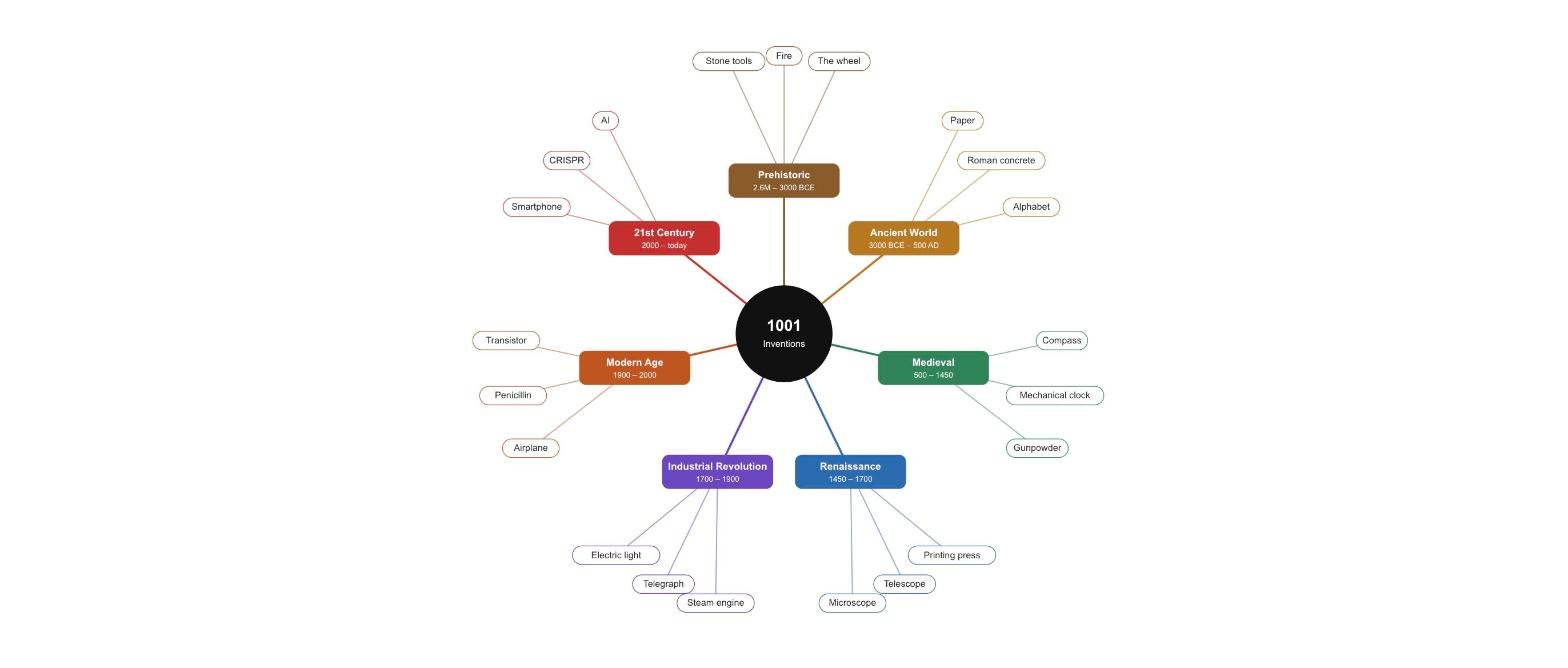
Another ancient engineering marvel.Mind map of all inventions
See the whole story in one map.
Sources
- Wheel, Encyclopaedia Britannica
- History of transportation, Encyclopaedia Britannica
- Sun Temple, Konarak, UNESCO World Heritage Centre
- Ljubljana Marshes Wheel, Wikipedia
Featured image: Image: Standard of Ur, British Museum, via Wikimedia Commons, Public domain. Dates for early events are approximate.


5 Comments
[…] Prehistoric Technology & Engineering Transportation Oct 21, 2026 […]
[…] Prehistoric Technology & Engineering Transportation Oct 21, 2026 […]
[…] Prehistoric Technology & Engineering Transportation Oct 21, 2026 […]
[…] Prehistoric Technology & Engineering Transportation Oct 21, 2026 […]
[…] Prehistoric Technology & Engineering Transportation Oct 21, 2026 […]