
The Smartphone: From a 1973 Street Call to a Computer in Every Pocket

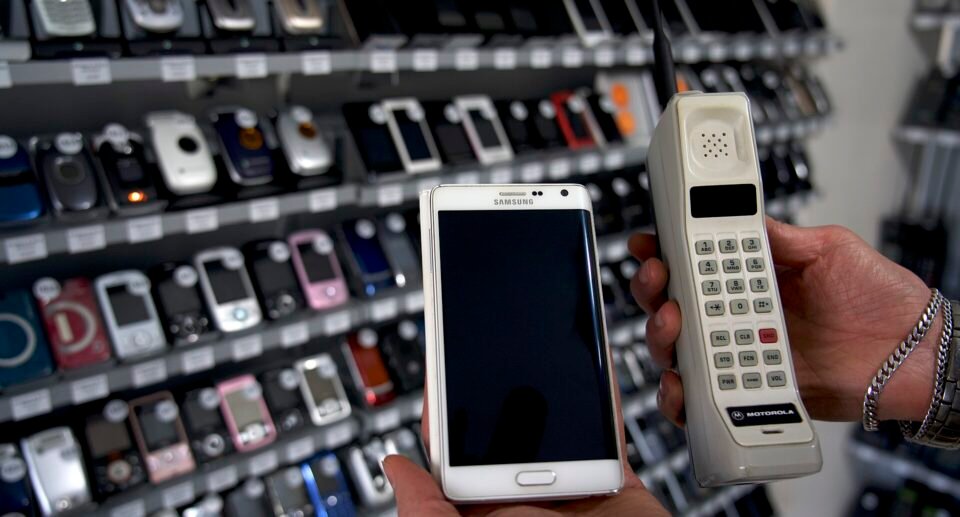
In 1973 a man stood on a New York street and made the first call from a handheld mobile phone. His phone weighed about as much as a bag of sugar, and the call lasted a few minutes. Half a century later, billions of people carry a device that is also a camera, a map, a bank branch, a music studio and a computer more powerful than anything the Apollo astronauts had. This guide traces how that happened, what is actually inside the glass slab, and how India became one of its biggest markets.
| First handheld call | 3 April 1973, Martin Cooper of Motorola |
| First commercial handheld | Motorola DynaTAC 8000X, 1983 |
| First touchscreen smartphone | IBM Simon, 1994 |
| Modern turning point | iPhone (2007), App Store and Android (2008) |
| Key technologies | Cellular networks, lithium-ion batteries, capacitive touchscreens, microchips |
| Reading time | 10 min read |
The call that started it
Before mobile phones, telephones were tied to a wire. Car phones existed from the middle of the 20th century, but they were bulky and needed a vehicle’s power. The idea of cellular networks, in which an area is divided into small “cells”, each with its own tower, was developed at Bell Labs in the 1940s and 1950s. The cells allow the same radio frequencies to be reused in different places, which lets thousands of people talk at once.
On 3 April 1973 Martin Cooper, an engineer at Motorola, stood on a Manhattan street and called Joel Engel, a rival at Bell Labs, from a prototype handheld phone. The device that would become the Motorola DynaTAC 8000X went on sale ten years later, in 1983. It weighed about 800 grams, offered around half an hour of talk time, needed about ten hours to charge and cost nearly four thousand dollars.
From phone to smartphone
The first phones did only one thing. The idea of adding a computer came early. In 1994 IBM and BellSouth launched the IBM Simon Personal Communicator, which had a touchscreen, an address book, a calendar, email and fax. It was a commercial flop, but its ideas were right. In 1996 Nokia released the 9000 Communicator with a full keyboard, and BlackBerry devices in the early 2000s made email in your pocket a business tool.
These phones were clever but awkward: small keyboards, styluses, and menus designed for a desktop. The leap needed a different idea about how people should interact with a computer.
2007: the touchscreen revolution
On 9 January 2007, Apple’s Steve Jobs unveiled the iPhone, and it went on sale in June of that year. Its main idea was a large multi-touch screen that you could operate with your fingers, with no physical keyboard. It ran a real operating system and a full web browser. In 2008 Apple opened the App Store and Google released Android, with HTC’s Dream (T-Mobile G1) as the first Android phone. The App Store let anyone write software that could run on the phone, and the mobile app economy was born. You can read more in our guide to mobile apps.
Try it: how a touchscreen finds your finger
Most phone screens are capacitive. A grid of tiny electrodes under the glass senses a change in electric field when a conductive object, such as a finger, comes close. Move your pointer (or finger) over the grid. Each cell reports a signal strength, and the phone estimates your position by taking a weighted average of all the signals.
What is inside, step by step
You touch the glass
Your finger changes the electric field around the nearest sensor electrodes under the glass.
The controller chip reads the change
A touch controller measures every cell of the grid many times a second and works out where your finger is, as in the demo above.
The processor interprets it
The main chip, a system-on-a-chip with billions of transistors, tells the operating system that you tapped at that spot.
An app responds
The operating system passes the tap to the app under your finger, which decides what it means: open a link, press a button or draw a line.
The screen updates
The app redraws the screen, and the display shows the result, typically in less than a tenth of a second.
A phone vs the Apollo computer
The Apollo Guidance Computer that took astronauts to the Moon in 1969 had about 4 kilobytes of working memory. Here is how far a modern phone with 8 gigabytes of memory has come, in a few lines of Python.
apollo_ram_kb = 4                     # approx. working memory of the Apollo Guidance Computer
phone_ram_gb = 8
phone_ram_kb = phone_ram_gb * 1024 * 1024
print(f"Phone memory is {phone_ram_kb // apollo_ram_kb:,}x the Apollo computer's RAM")
Output:
Phone memory is 2,097,152x the Apollo computer's RAMThat is only memory. Processing speed, storage and connectivity have grown by similar factors, thanks to the shrinking of the transistor.
1973: First handheld call
Martin Cooper calls Joel Engel from a Motorola prototype.
1983: DynaTAC 8000X
The first commercial handheld mobile phone.
1994: IBM Simon
A phone with a touchscreen, email and apps.
1996: Nokia 9000
A communicator with a full keyboard.
1999-2002: BlackBerry
Pocket email makes mobile devices a business essential.
2007: iPhone
Multi-touch and a real web browser on a phone.
2008: App Store and Android
Third-party apps and an open phone platform arrive.
2016: Cheap data in India
Reliance Jio launches and mobile data prices fall sharply; UPI payments take off on phones.
Smartphones in India
India’s first mobile call was made on 31 July 1995 between Kolkata’s Writers’ Building and New Delhi, when West Bengal’s chief minister Jyoti Basu called Union Telecom Minister Sukh Ram. For years afterwards mobile calls were expensive, but prepaid plans and competition lowered prices steadily.
The biggest change came in 2016. Reliance Jio launched with very low-cost mobile data, and data prices across the country fell sharply. In the same year the National Payments Corporation of India launched the Unified Payments Interface (UPI), which lets people pay from a phone through a bank-linked app. India is now among the world’s largest smartphone markets, and a large share of the phones sold in the country are assembled locally. For many Indians the smartphone is the first and only computer they use, for payments, video, study and small business.
Mind map: the smartphone at a glance
- Smartphone: A phone, camera, map and computer in one slab of glass.
- Mobile phones: From brick to pocket.
- Cooper, 1973: First handheld cellular call.
- DynaTAC, 1983: First commercial handheld: about 800 g.
- Digital GSM: 2G phones and text messages.
- Early smartphones: Phone plus computer.
- IBM Simon, 1994: Touchscreen, email and apps.
- Nokia 9000, 1996: Communicator with a keyboard.
- BlackBerry: Pocket email for business.
- The modern phone: 2007 onwards.
- iPhone, 2007: Multi-touch screen and no keyboard.
- App Store, 2008: Third-party apps at scale.
- Android, 2008: Open platform from Google.
- What is inside: Sensors and chips.
- Processor: Billions of transistors.
- Touchscreen: Capacitive grid.
- Camera: Phones replace compact cameras.
- GPS and compass: Location and direction.
- Battery: Lithium-ion.
- India: The second-largest market.
- First call, 1995: Kolkata, 31 July.
- Jio, 2016: Cheap mobile data.
- UPI: Payments in a few taps.
- Local assembly: Phones made in India.
- Mobile phones: From brick to pocket.
Common myths
- Myth: The iPhone was the first smartphone. Earlier devices like the IBM Simon and BlackBerry came before; the iPhone popularised multi-touch and apps.
- Myth: The first mobile phone was small. The first handheld weighed about 800 grams, and early prototypes were heavier.
- Myth: A phone just has a lot of processing power. Its sensors, camera and network connections are equally important.
- Myth: Phone batteries invented new chemistry for phones. They use lithium-ion technology developed from the 1970s to the 1990s.
Key takeaways
- Cellular networks, small batteries, touchscreens and chips all had to mature before the smartphone could exist.
- Martin Cooper made the first handheld call in 1973; the iPhone and Android changed the game in 2007 and 2008.
- A touchscreen finds your finger by comparing signals from a grid of sensors.
- In India, cheap data and UPI turned the smartphone into a daily tool for payments and information.
Frequently asked questions
Why do phones get warm?
The chips and battery produce heat when they work hard or charge. Phones are designed to shed it, but intense use can make them warm.
What is a system-on-a-chip?
A single chip containing the processor, graphics, memory controller and often modem and other parts, which saves space and power.
Why did early phones have antennas that stuck out?
They improved reception. Antenna designs became smaller and moved inside the case as engineers learned to make them more efficient.
What is 5G?
The fifth generation of mobile networks, designed for higher speeds, lower delay and many more connected devices than 4G.
Keep exploring
How phones became a platform for software.The transistor
The switch behind every chip.Photography
How the camera in your pocket came about.
Sources
- Smartphone, Encyclopaedia Britannica
- Martin Cooper, Encyclopaedia Britannica
- iPhone, Encyclopaedia Britannica
- Android operating system, Encyclopaedia Britannica
- National Payments Corporation of India, NPCI
Featured image: Image: Umut Çolak, via Wikimedia Commons, Public domain. Dates for early events are approximate; sizes and prices are rounded.



2 Comments
[…] The transistorThe hardware beneath every AI system.ZeroThe binary idea that all computing rests on.The smartphoneWhere most people meet AI daily. […]
[…] The SmartphoneThe camera most people use today.The TransistorThe part inside every digital sensor.PaperThe material of Talbot’s first negatives.Mind Map hubWhere photography fits in the big picture. […]